
Emergency Communication Preparedness Guide
A comprehensive guide to maintaining communication capabilities during disasters, infrastructure failures, and emergencies using radio, satellite, and alternative methods.
Ukko Selvace
Communications Specialist
While food, water, and shelter are essential to survival, communication is what truly distinguishes humanity. Our capacity for complex language enabled civilization, society, trade, and development. When disaster strikes, communication should rank alongside immediate survival as a top priority.
Many survival and disaster stories share a common thread: the main thing that sets apart those who survived and those who perished was communication.
Emergency communications encompasses a vast range of subjects and scenarios. Consider these illustrative examples:
-
Columbine shooting (1999): Overwhelming call volume flooded cell networks across the district. The only way 911 dispatchers learned about the situation was through radio transceivers owned by school officials trained in emergency comms.
-
2010 Copiapó mining accident (Chile): 33 miners were trapped for 70 days. Seventeen days after the collapse, a note was discovered taped to a rescue drill bit: “Estamos bien en el refugio los 33” (“We are well in the shelter, the 33 of us”).
-
Government-initiated communication shutdowns: Numerous instances where authorities suspended cell phone and internet service, including the Myanmar 2021 military coup, the Hong Kong 2019-2020 protests, Russia’s 2022 anti-war protests, Iran’s 2019 fuel price protests, the 2020 George Floyd protests in Portland, the 2016 Dakota Access pipeline protests, the 2019-2020 Catalonian protests in Spain, and the 2024 UK riots. These shutdowns lasted days, weeks, and some stretched into months, affecting hundreds or thousands of people.
Being cut off from information can mean missing evacuation orders, road and hazard updates, or opportunities for aid. In a small or isolated community, a single person with long-range communications capability can become the sole link between vital resources and their neighbors.
Tip: This guide’s information is largely US-centric; non-US readers should research local laws and customs. The intent is to teach readers how to contact someone who can help, even during an emergency or prolonged infrastructure collapse.
Preparedness
Preparedness is a deep, comprehensive topic covering contingencies for food, shelter, transportation, clothing, sanitation, entertainment, and communication, all organized around a threat model. Depending on one’s location and circumstances, relevant hazards might include blizzards, disease outbreaks, radiation, earthquakes, wildfires, political violence, floods, government collapse, heat waves, cold snaps, hurricanes, typhoons, war, and more.
Threat Modeling
Threat modeling is the methodology for estimating the likelihood of disruptive bad outcomes in daily life, preparing contingencies, and then layering additional contingencies on top.
Most people already practice this instinctively — keeping a spare tire in the trunk, or downloading offline maps in case of getting lost. You were capable of doing it before, and you are still capable now.
Contingency Theory
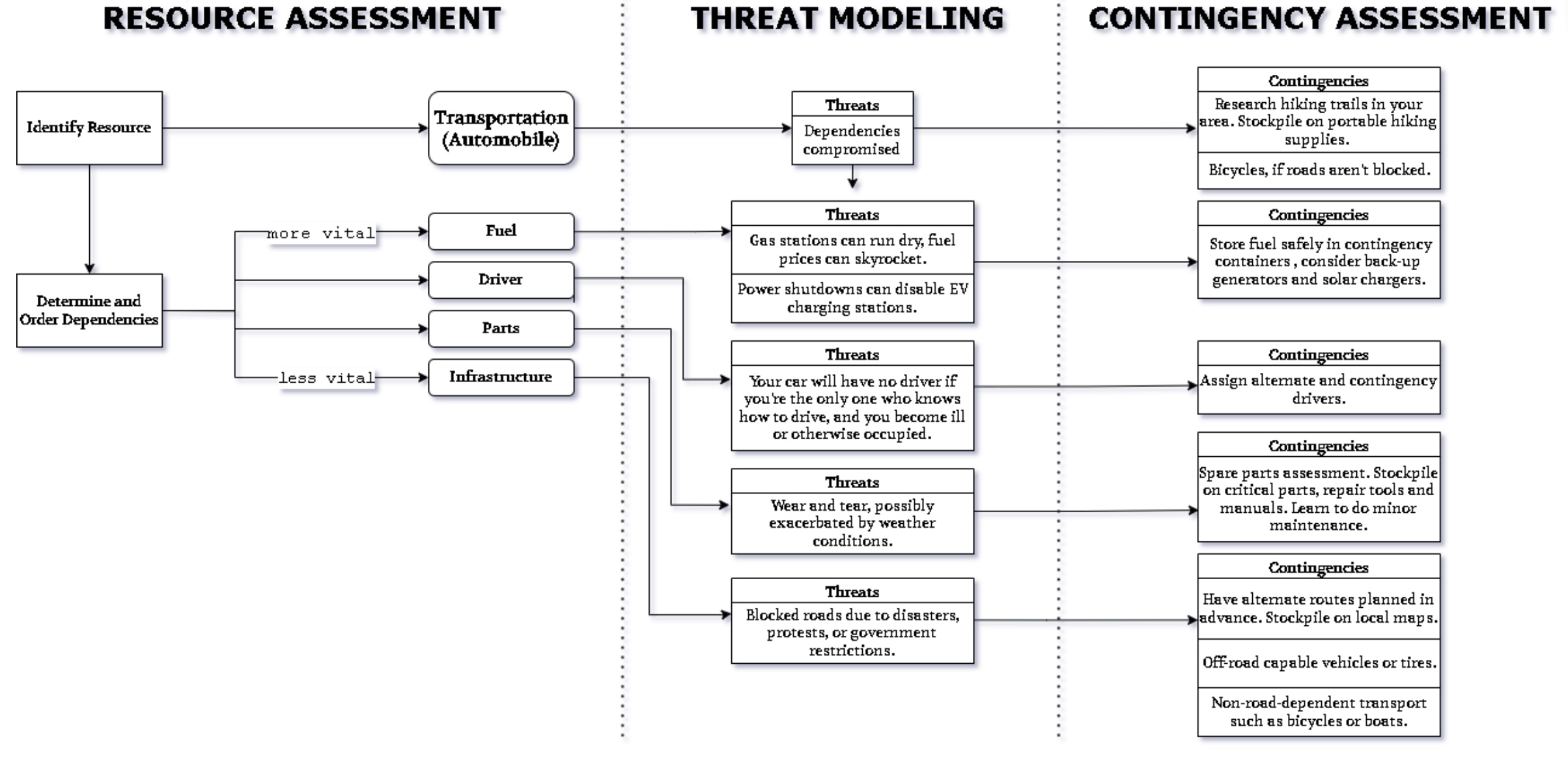
A contingency is a “provision for a possible event or circumstance.” The core principle is that a strong contingency should replace a resource at “exponential value,” meaning backup options shouldn’t depend on the same services and infrastructures, preventing a single point of failure from compromising multiple options simultaneously.
Tip: Relying on a motorcycle as backup for a car is insufficient because both depend on gasoline. If fuel becomes scarce, both options fail. The ideal approach is creating a contingency for the underlying resource (gasoline), the car itself, or both.
This methodology applies universally to all contingency planning. Understanding what secondary resources your primary resources depend on is critical.

The PACE System
The PACE system is a framework for contingency planning around information infrastructure breakdown. PACE stands for Primary, Alternate, Contingency, and Emergency. In an emergency, proceed from top to bottom:
Primary
The best available, everyday communication method — most widely applicable in your area. Typically social media, e-mail, or phone calls and texts.
Alternate
A widely-used but less optimal method, used when the Primary device or its supporting infrastructure fails. Should run on completely different systems and be a completely different device. Examples include satellite internet services (Hughesnet, Viasat, Starlink) and satellite phones (Iridium, Inreach Messenger, SPOT).
Contingency
Less convenient but more reliable. Should not rely on any pre-existing infrastructure, though it need not always be on standby — just something you know how to deploy. Radio communications are the most obvious choice, described as “robust and impossible to dismantle.” A mini-PACE priority system is recommended within this tier.
Emergency
A last resort when even the contingency device is compromised. Not built for casual conversation — only for carrying vital information to those who need it. Examples include distress beacons, flashing lights in Morse code, and written messages.
Primary Communications
-
Maintain emergency contacts. Build a list including emergency services, a family contact sheet, and ICE (“In Case of Emergency”) contacts in your cell phone.
-
Call 911 only for life-threatening emergencies. Phone lines are surprisingly easy to clog up in a disaster. Non-life-threatening situations should be directed to the police or fire department directly.
-
Use social media instead of voice calls. Data-based services (texts, emails) are less prone to network congestion. Social media can also broadcast your status to family and friends.
-
If a cell call fails, wait ten seconds before redialing to help reduce network congestion.
-
Conserve cell phone battery by reducing screen brightness, using airplane mode, and closing unnecessary apps.
-
Charge your phone in your car if you lose power, ensuring the car is in a well-ventilated area (not in a garage). The car radio can also serve as a source for news and alerts.
Do You Need a Radio?
A radio should always be part of a disaster kit, but exhaust other communication methods first. Reference the PACE framework — there’s no reason to jump to radio if you haven’t yet tried a satellite phone. Only when primary and alternate options fail should you move to your contingency device.
Warning: In wilderness use, the chance of finding a nearby listener to relay your signal is low, and even if contact is made, the challenge of being physically located remains.
Contingency Communications
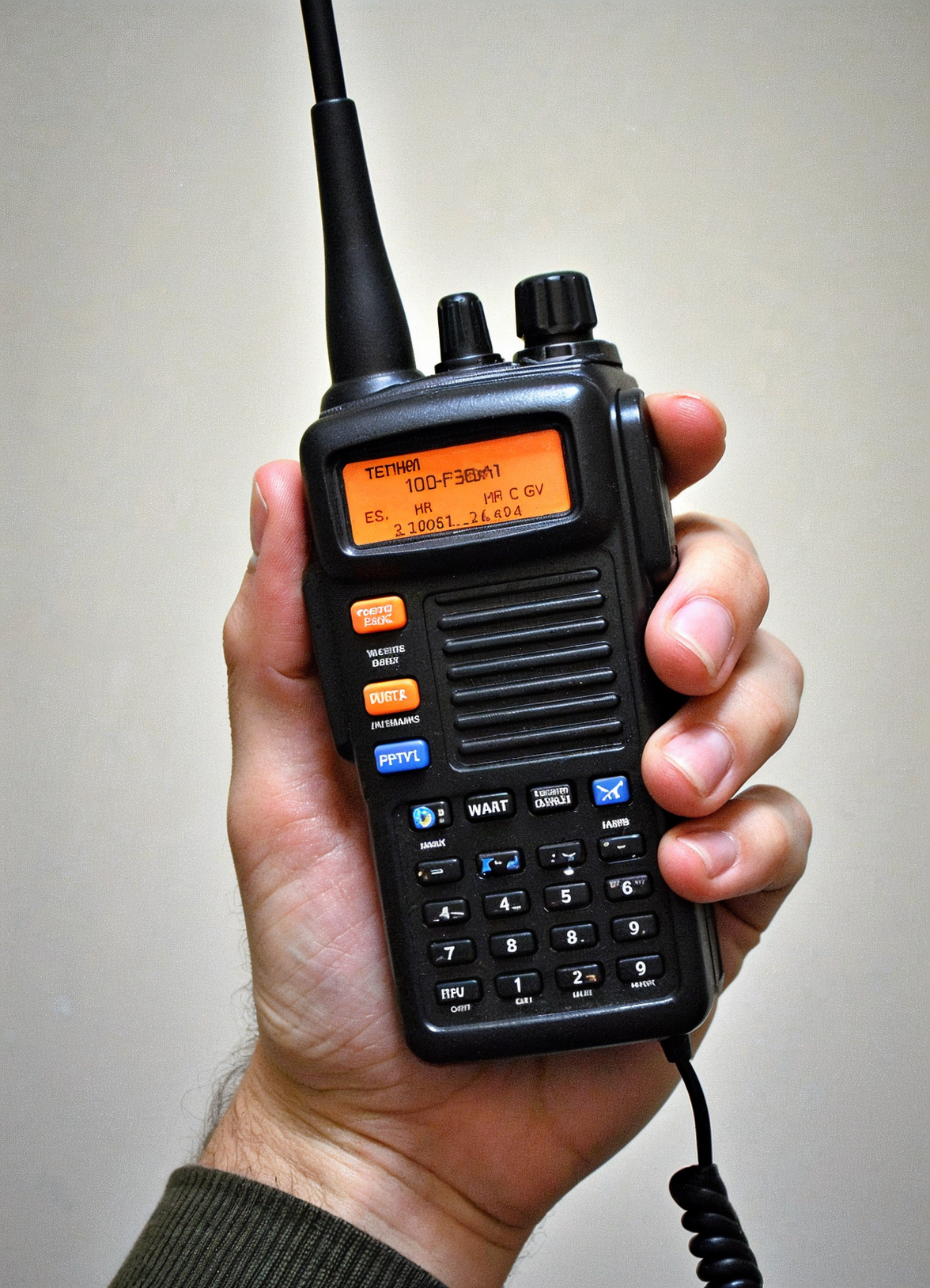
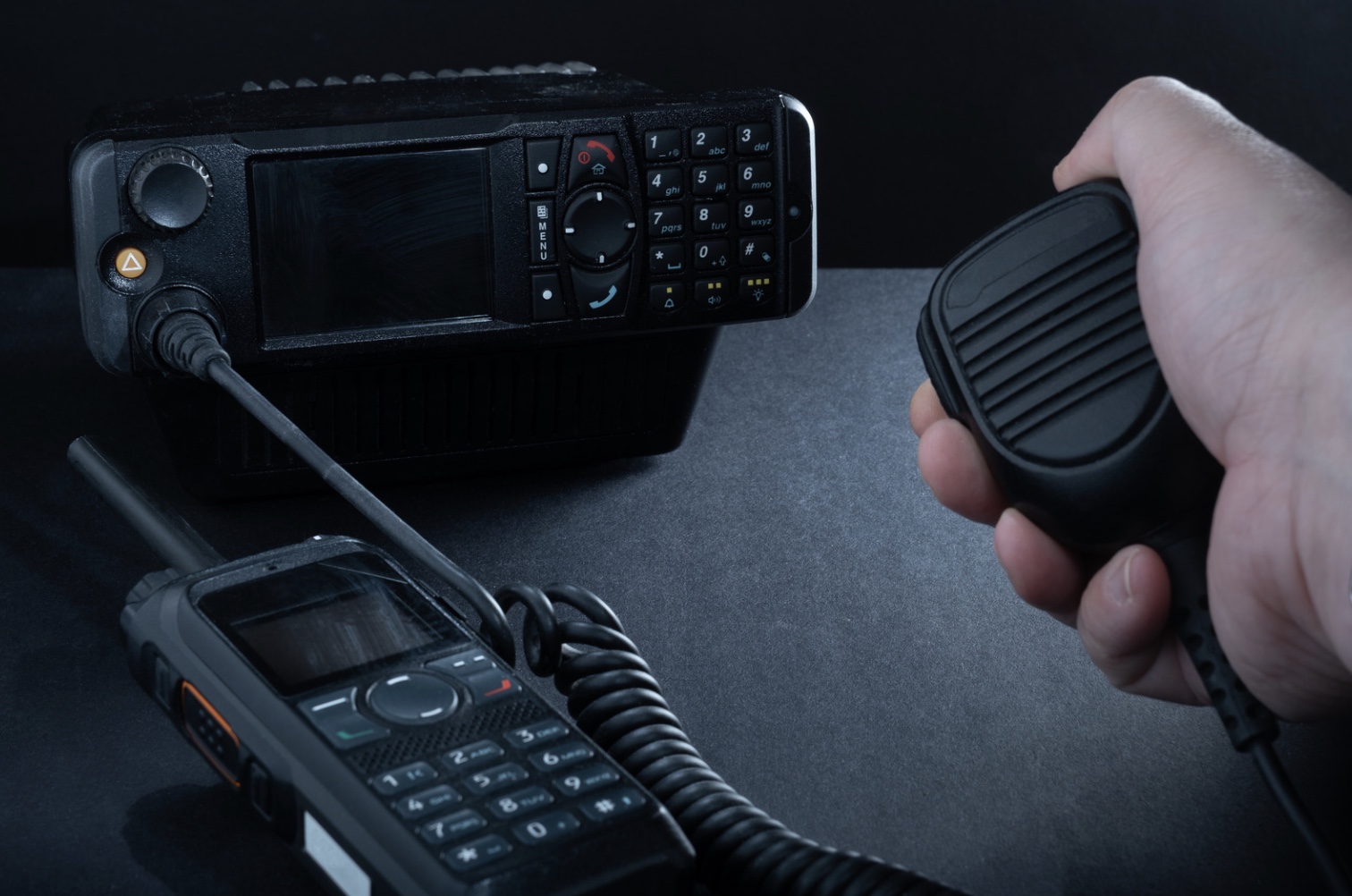
Ham radio is the default contingency when internet and cell service fail. Ham radio encompasses far more than walkie-talkie-style communication:
- FT8, JS8Call, Fldigi — Digital modes enabling global communication with extremely low power
- Winlink — Email over radio networks, predating the internet
- SSTV (Slow Scan Television) — Transmitting images via tones over radio
- APRS (Automated Packet Reporting System) — Tracking positions of aircraft and vehicles
- AMSAT — Communicating with people on Earth and aboard the ISS via amateur radio satellites in low Earth orbit
Ham radio is extremely long-range, resilient, and decentralized. Listening to any radio communication is completely legal; legal issues arise only when transmitting on non-consumer bands without a license.
Legal Information
Transmitting over most radio bands without a license is generally illegal, with potential penalties including fines and equipment confiscation.
However, FCC Rule 97.405 provides that amateur stations in distress may use any means at their disposal to attract attention and obtain assistance, and that other stations may assist them.
Tip: Keep radio equipment for listening and emergency use. For regular ham radio use, obtaining a license is relatively straightforward and provides the skill set for efficient emergency transmission.
Getting a Ham License
The FCC license database is public. It contains government names and addresses and is easy to search. For those wanting privacy, using a P.O. Box or alternate address is recommended.
Three tiers of Ham licenses exist: Technician, General, and Extra. The Technician license exam consists of 35 multiple-choice questions drawn from a pool of 428, with a passing score of 74% or higher. All questions and answers are publicly available. hamstudy.org offers study tools and tracks average scores before offering practice tests.
Tip: Consistently scoring 80% on practice tests indicates readiness for the real exam. As of April 19, 2022, the FCC charges a $35 application fee, though VECs typically waive the $15 exam fee they previously charged.
License-Free Radio: CB Radio
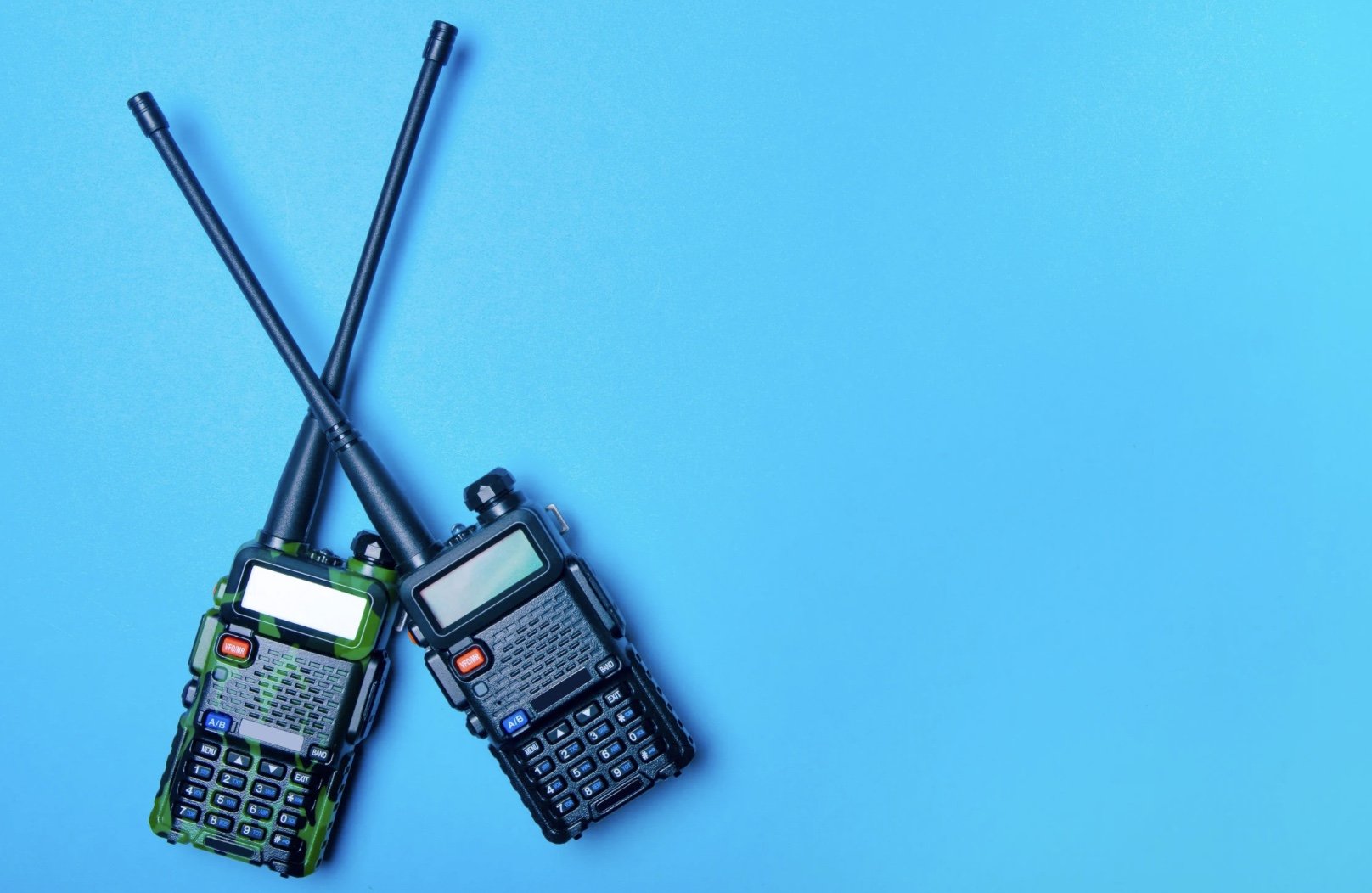
Before cell phones, CB (Citizen’s Band) radios were widely used in rural areas. Houses and tractors both had CB radios so family members could stay in contact during the workday. School buses also carried CBs to notify families of arrival times.
Basics of Radio
Radios and antennas function by transmitting, receiving, and interpreting electromagnetic waves. The process breaks into three stages:
- Transmission: A radio transmitter converts electrical signals (such as voice) into waves.
- Propagation: The waves travel through air or space at the speed of light, reflecting and refracting based on obstacles and atmospheric conditions.
- Reception: A radio receiver with an antenna captures waves and converts them back into electrical signals.
From these stages, radio communication requires only two components: a transmitting device and a receiving device, both needing an antenna.
Choosing a Radio
For a radio setup aimed at receiving instructions and information during infrastructure collapse, two items are recommended:
-
RTL-SDR, or other SDR (Software Defined Radio). This is a USB device plugged into a computer and tuned using software like SDR# or GQRX to listen to various frequencies. RTL-SDRs are available online at low cost.
-
Baofeng UV-5R, Quansheng UV-K5, or other VHF/UHF transceivers. These can transmit, but transmitting on amateur bands without a license is illegal unless there is an emergency.
Public Alerts: NOAA NWR All Hazards
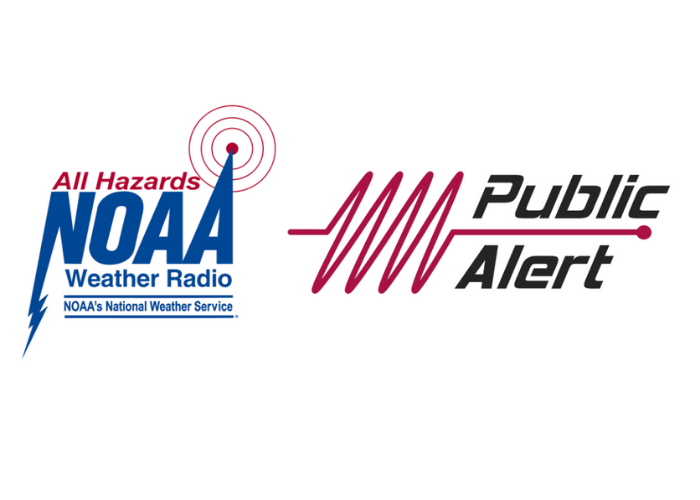
Look for radios tagged with “Public Alert” or “NOAA NWR All Hazards” logos.
These radios are compatible with SAME (Specific Alert Message Encoding) technology, delivering area-specific alerts from a specified county. Some weather receivers allow users to program specific SAME codes for local and surrounding counties.
Power Sources
Battery operated radios are most convenient with additional batteries stocked. Emergency radios are built to sip power, but extras like flashlights, solar panels, or speakers increase power drain.
Tip: A hand-cranked radio is not necessarily more efficient than carrying extra batteries for a low-power radio.
AM and FM
- AM (Amplitude Modulation): More stable over long distances, uses lower frequency bands — often used for emergency alerts and services.
- FM (Frequency Modulation): Transmits with better sound quality but shorter range, in higher frequency bands.
Frequency Bands
Radio waves have an attribute called frequency, measured in Hertz (Hz) and its magnitudes, most often Kilohertz (kHz) and Megahertz (MHz).
The gap between 3.5 MHz and 450 MHz is the most useful range to monitor.
| Abbrev. | Name | Frequency | Used for |
|---|---|---|---|
| VLF | Very Low Frequency | 3-30 kHz | Navigation, Timekeeping, Navy Communications |
| LF | Low Frequency | 30-300 kHz | Broadcasting |
| MF | Medium Frequency | 300 kHz-3 MHz | AM radio broadcasts, air traffic control |
| HF | High Frequency | 3-30 MHz | Shortwave radio, amateur radio, Citizen’s Band |
| VHF | Very High Frequency | 30-300 MHz | Digital audio, FM radio broadcasts, TV broadcasts |
| UHF | Ultra High Frequency | 300 MHz-3 GHz | Cellphones, satellite, GPS, Wi-Fi, walkie-talkies |
| SHF | Super High Frequency | 3-30 GHz | Radar, wireless LANs, microwave relay links |
The 3-3-3 Survivalist Radio Plan
The 3-3-3 plan represents the “When, Where, and How” of making radio contact.
The plan is simple: Turn on your radio every 3 hours. Tune to channel 3. Listen for 3 minutes.
When: Every 3 Hours
Use Local Time for local communications, at the top of the hour:
Noon, 3pm, 6pm, 9pm. Midnight, 3am, 6am, 9am.
How Long: For 3 Minutes
At the top of every 3rd hour, turn on your radio. Always listen for at least 3 minutes, even without needing to make a call — someone may be reaching out for help.
Where: Channel 3
Channel 3 applies to CB, FRS, or MURS — the most common civilian radio types.
Tip: Without a watch, try listening to an AM broadcast station — they identify their call letters at the top of each hour.
Official Emergency Frequencies
- CB (26.965-27.405 MHz): Emergency channel is Channel 9 at 27.065 MHz
- MURS (462.5625-462.725 MHz): Emergency channel is Channel 3 at 151.9400 MHz
- 146.520 MHz and 145.500 MHz: National simplex calling frequencies
- 146.000-148.000 MHz: Common frequencies for local police, fire, and EMS
- 162.400-162.550 MHz: NOAA weather radio broadcasts
Tip: If all of these remain quiet for too long, it may be time to try amateur frequencies.
Antennas and Amplitude
Antenna length typically equals 1/4 wavelength due to resonance, making it the most efficient. References to “the 2 meter band” indicate that the wavelength equals two meters.
When receiving, there is significant flexibility in what can serve as an antenna. When transmitting, however, the antenna must be tuned in resonance with the target frequencies.
Warning: Using improper material or an incorrect length causes power to reflect back into the transmitter rather than radiating from the antenna. At best this produces a noisy, garbled signal; at worst, it can permanently burn out your radio.
Antenna Height vs. Power
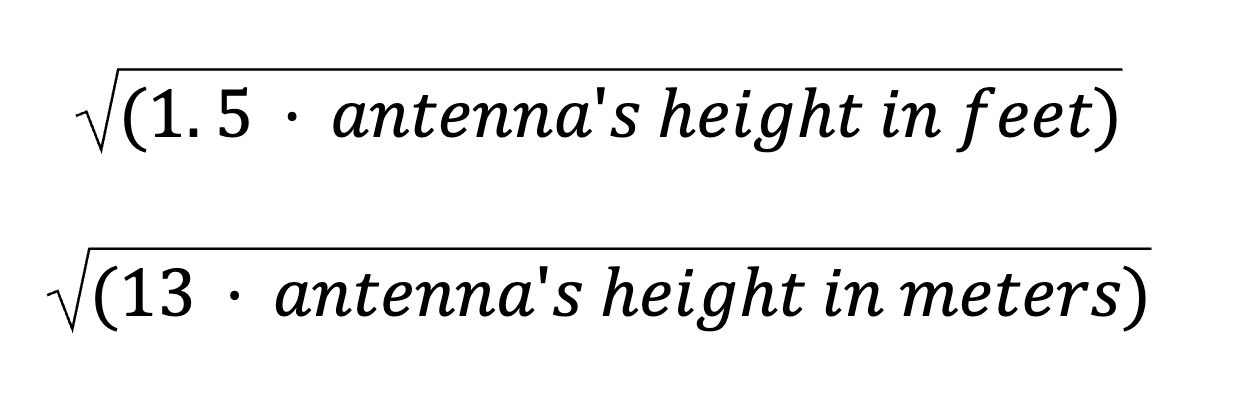
Antenna height matters substantially more than power. VHF/UHF communication is “Line of Sight” because frequencies above 30MHz cannot pass through large buildings, mountains, or Earth’s curvature.
Examples of effective range by antenna height:
- Holding a walkie-talkie at ear level (~6 ft): ~3 miles
- Antenna atop a 2-story house (~25 ft): ~6 miles
- Adding a 10 ft mast to that rooftop: ~7 miles
Whips and Monopoles
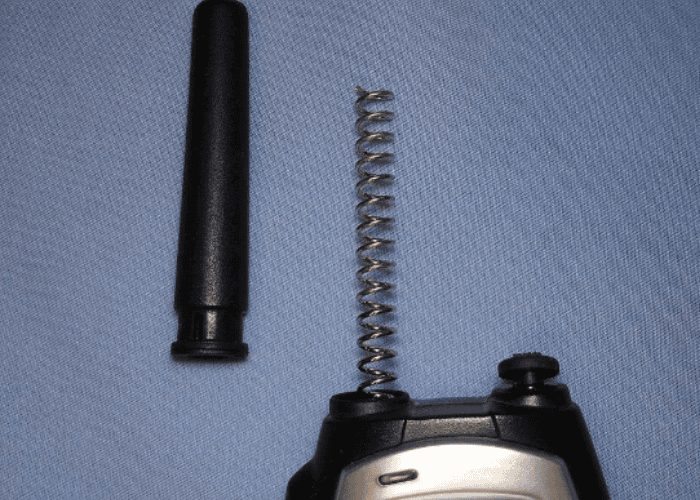
Common on cars, HTs, and walkie-talkies. Includes “rubber ducks” — small rubber-covered antennas on handheld radios. Adequate for short-range communication.
Dipoles
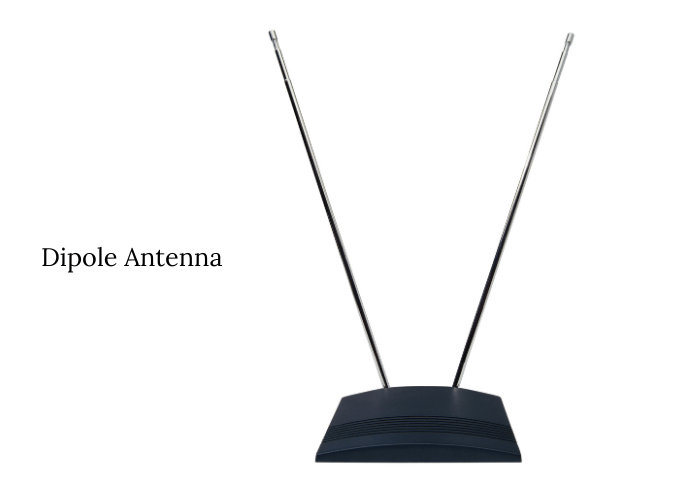
Two equal-length wires extending from a coaxial cable. The familiar “rabbit ears” from older TVs. Distribute signal more evenly and require no grounding, but lower bandwidth.
Ground Planes
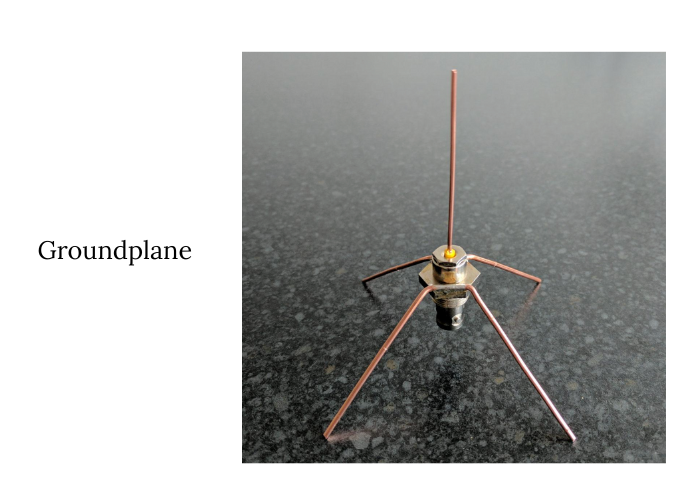
Five wires of equal length, each 1/4 the target wavelength. Purpose-built for efficient propagation within design frequency, yielding greater range and signal strength.
J Poles
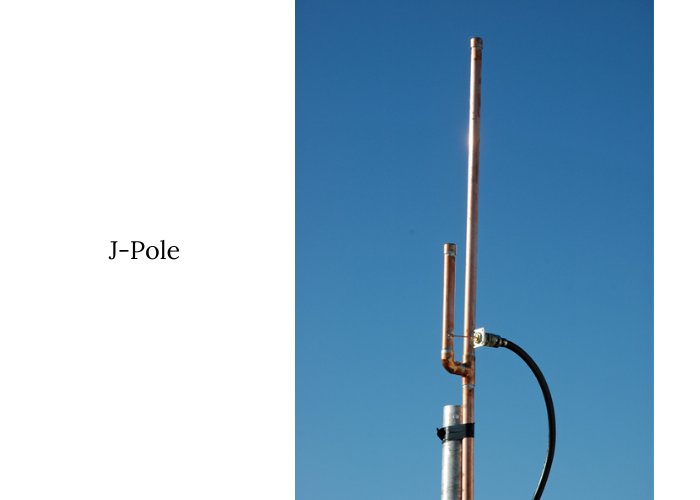
Typically constructed from copper pipe. Durable and high gain. Do not require a separate ground plane, making them easier to mount on a roof or pole and resistant to strong winds.
Slim Jims
Frequently built from “ladder line,” which can be rolled up and carried in a backpack. Deploy by attaching to a rope and throwing into a tree or elevated location.
Tip: For those with preparation time, Slim Jims are the most adaptable for emergency situations. A Slim Jim allows you to get atop any tall building, structure, or even a tree.
Extending Your Range
Beyond raising antenna height, boosting radio power output is another option, but requires formal radio technician training.
Warning: Jury-rigging your radios for more wattage is ill-advised. Exceeding signal strength guidelines for each band is illegal and can interfere with or jam other communications.
The remaining option is repeaters — radios that receive and re-transmit signals to cover longer distances or bypass large obstacles. Most cities with at least a thousand residents will have at least one repeater.
How to Use a Repeater
1. Find a Repeater
Repeaters are discovered via repeaterbook.com or word of mouth. You need four key pieces of data:
- Input frequency — the frequency the repeater expects to receive on
- Output frequency — the frequency it re-transmits on
- Frequency offset — the difference between input and output
- Access tone — a special tone required to activate the repeater
2. Tune Your Radio
Set your listening frequency to the repeater’s output. Enter the offset via Duplex Mode setting. Configure the access tone via CTCSS setting.
3. Transmit
Your signal passes through the input frequency into the repeater and is broadcast on the output frequency you’re monitoring.
Tip: If internet is still available, Repeaterbook.com is invaluable. If not, 146.2 is the most common repeater frequency and a good starting point.
Communication Protocol
Radio signals are unreliable, affected by wind, time of day, humidity, and atmospheric conditions. Specific procedures help keep exchanges useful and clear:
- Pause briefly after pressing PTT before speaking.
- Open with “Emergency, emergency, emergency.” Stating the purpose three times is standard procedure.
- Be brief. Don’t hold PTT for longer than 30-45 seconds.
- Do not transmit while the other person is transmitting.
- Speak clearly and directly. Take your time; repeat information if needed.
- Use the NATO phonetic alphabet for spelling addresses, names, and license plates.
Conclusion
This guide covers the basics of radio functioning and protocols — a pragmatic overview of ham radio and related technologies. Additional frequencies and emergency frequency references are provided in accompanying tables.
Stay safe, stay prepared, and most importantly — stay in touch.
Communications Specialist
Emergency communications specialist and Prepper Disk staff writer. Expert in ham radio, PACE systems, and contingency communication planning.